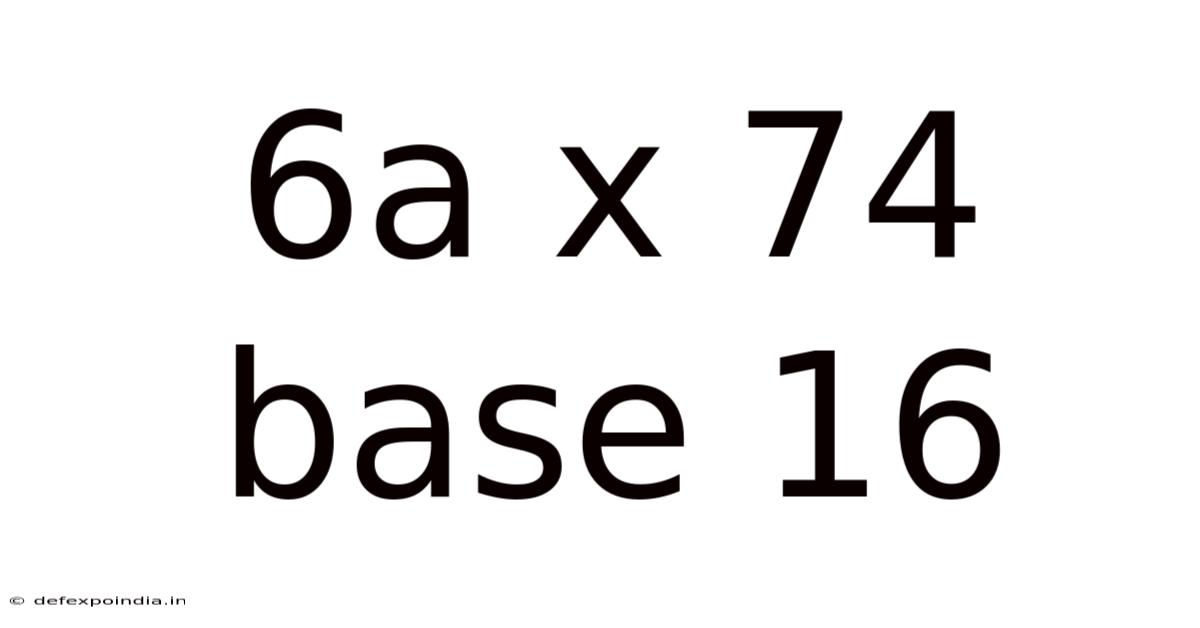
Decoding 6A x 74: A Deep Dive into Hexadecimal Multiplication
Hexadecimal, or base-16, is a number system crucial in computer science and digital electronics. Still, understanding hexadecimal multiplication is fundamental for anyone working with low-level programming, data representation, or digital signal processing. This article will provide a practical guide to multiplying hexadecimal numbers, focusing on the example 6A x 74, explaining the process step-by-step, and exploring the underlying principles. We'll move beyond simple calculation to get into the practical applications and implications of this seemingly basic arithmetic operation Most people skip this — try not to..
Understanding Hexadecimal Numbers
Before tackling the multiplication, let's refresh our understanding of the hexadecimal system. Unlike the decimal system (base-10), which uses digits 0-9, hexadecimal uses sixteen digits: 0-9 and A-F, where A represents 10, B represents 11, C represents 12, D represents 13, E represents 14, and F represents 15. Each position in a hexadecimal number represents a power of 16.
6A(hexadecimal) = (6 x 16¹) + (10 x 16⁰) = 96 + 10 = 106 (decimal)74(hexadecimal) = (7 x 16¹) + (4 x 16⁰) = 112 + 4 = 116 (decimal)
This conversion between hexadecimal and decimal is vital for understanding the calculations.
Method 1: Converting to Decimal, Multiplying, and Converting Back
This method is straightforward and relies on our familiarity with decimal arithmetic.
Steps:
-
Convert to Decimal: Convert both hexadecimal numbers (
6Aand74) to their decimal equivalents as shown above.6Abecomes 106 and74becomes 116. -
Multiply in Decimal: Perform the multiplication using standard decimal arithmetic: 106 x 116 = 12296.
-
Convert Back to Hexadecimal: Now convert the decimal result (12296) back to hexadecimal. This involves repeatedly dividing by 16 and recording the remainders:
- 12296 ÷ 16 = 768 remainder 8
- 768 ÷ 16 = 48 remainder 0
- 48 ÷ 16 = 3 remainder 0
- 3 ÷ 16 = 0 remainder 3
Reading the remainders from bottom to top gives us the hexadecimal result:
3008The details matter here..
That's why, 6A x 74 (hexadecimal) = 3008 (hexadecimal) Most people skip this — try not to..
Method 2: Direct Hexadecimal Multiplication (Long Multiplication)
This method involves performing the multiplication directly in hexadecimal, similar to long multiplication in decimal. It requires understanding hexadecimal addition and multiplication tables Easy to understand, harder to ignore..
Steps:
-
Set up the Problem: Write the numbers as you would in long multiplication:
74 x 6A ---- -
Multiply by A (10): First, multiply 74 by A (which is 10 in decimal). Remember, we are working in base-16:
- A x 4 = 40 (hexadecimal). 40 hex = (4 x 16¹) + (0 x 16⁰) = 64 decimal. Write down 0 and carry-over 4.
- A x 7 = 70 (hexadecimal). 70 hex = (7 x 16¹) + (0 x 16⁰) = 112 decimal. Add the carry-over 4: 116 decimal = 74 hex. Write down 74.
This gives us the first partial product:
740Small thing, real impact.. -
Multiply by 6: Next, multiply 74 by 6:
- 6 x 4 = 24 (hexadecimal). 24 hex = 36 decimal. Write down 4 and carry-over 2.
- 6 x 7 = 42 (hexadecimal). 42 hex = 66 decimal. Add the carry-over 2: 68 decimal = 44 hex. Write down 44.
This gives us the second partial product:
444Turns out it matters.. -
Add the Partial Products: Add the two partial products, remembering to carry over when necessary in base-16:
   740
 + 444
 ------
  3008
So, 6A x 74 (hexadecimal) = 3008 (hexadecimal) Worth keeping that in mind. Less friction, more output..
Explanation of Carry-Overs in Hexadecimal Multiplication
The key to mastering hexadecimal multiplication is understanding how carry-overs work. When the result of a multiplication exceeds F (15), you must carry over the excess to the next higher position. For example:
- If you get 16 as a result, you write down 0 and carry-over 1 (because 16 = 1 x 16¹ + 0 x 16⁰).
- If you get 20 as a result, you write down 4 and carry-over 1 (because 20 = 1 x 16¹ + 4 x 16⁰). This is because 20 decimal is 14 hexadecimal (14 + 6 = 20; hence 4 in the current place and 1 in the next).
This process is consistent throughout the multiplication and addition steps It's one of those things that adds up..
Practical Applications of Hexadecimal Multiplication
Hexadecimal multiplication isn't just an academic exercise; it's a vital skill in many fields:
-
Low-level Programming: Many programming languages and systems use hexadecimal to represent memory addresses, data values, and color codes. Understanding hexadecimal multiplication is crucial for manipulating these values Small thing, real impact..
-
Digital Signal Processing (DSP): Hexadecimal is frequently used in DSP to represent digital signals and perform calculations on them Turns out it matters..
-
Computer Graphics: Hexadecimal codes are widely used to define colors (e.g., RGB values in web development) Worth keeping that in mind..
-
Networking: Network addresses and data packets are often represented in hexadecimal.
-
Data Representation: In data storage and retrieval, data is often represented in hexadecimal for compactness and ease of interpretation And that's really what it comes down to..
Frequently Asked Questions (FAQ)
-
Why is hexadecimal used instead of decimal? Hexadecimal offers a more compact representation of binary data (base-2). Each hexadecimal digit represents four binary digits (bits), making it easier to work with binary data.
-
Are there other bases used in computer science? Yes, binary (base-2), octal (base-8), and other bases are used depending on the specific application. That said, hexadecimal is particularly prevalent because of its compact representation of binary data.
-
What if I make a mistake during the hexadecimal multiplication? Carefully double-check your work, especially the carry-overs. You can also convert your intermediate results to decimal to verify their correctness Easy to understand, harder to ignore..
-
Are there any tools or calculators to help with hexadecimal multiplication? Yes, many online calculators and programming tools can perform hexadecimal calculations. Even so, understanding the manual process is crucial for deeper comprehension That's the part that actually makes a difference..
Conclusion
Hexadecimal multiplication, while seemingly complex initially, is a fundamental skill in several technical fields. By understanding the conversion between decimal and hexadecimal, and mastering the techniques of direct hexadecimal multiplication, you can confidently tackle these calculations. Remember to practice consistently to build proficiency and confidence in handling hexadecimal arithmetic. This comprehension lays the foundation for more advanced concepts in computer science and related disciplines. The step-by-step method explained in this article, along with the explanation of carry-overs, empowers you to not just perform the calculation but also understand the underlying principles. Mastering this seemingly basic operation unlocks a deeper understanding of the world of digital technology.
Real talk — this step gets skipped all the time It's one of those things that adds up..
