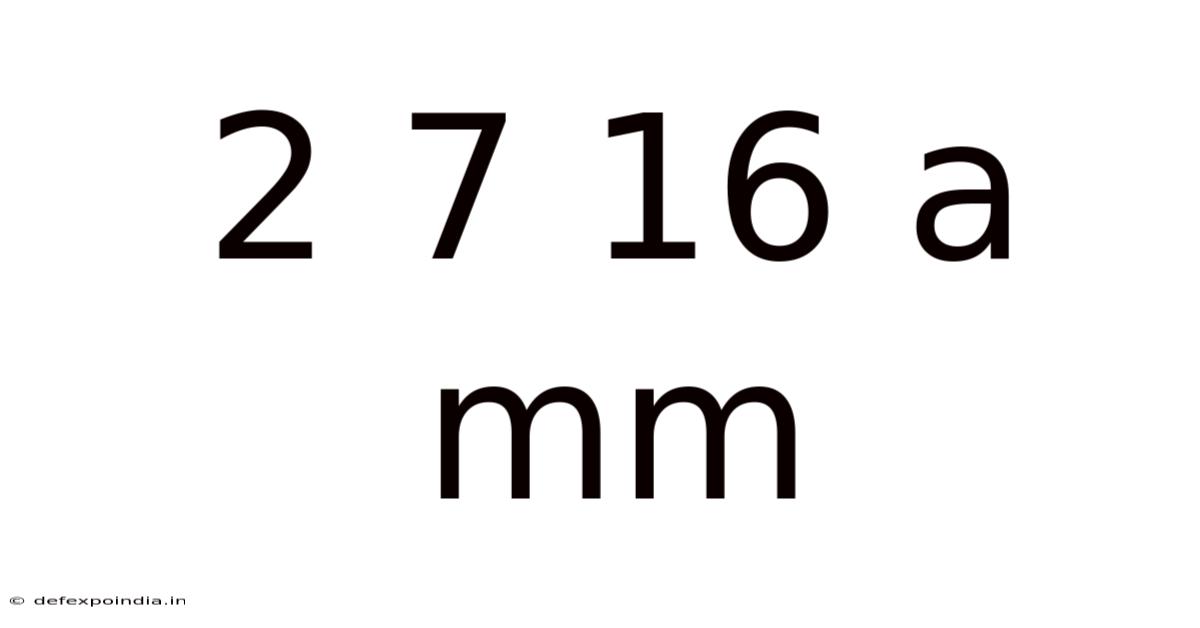
Decoding the Enigma: Understanding the Significance of "2 7 16 a mm"
The sequence "2 7 16 a mm" presents an intriguing puzzle. Because of that, this article explores various possibilities, examining mathematical patterns, alphabetical codes, measurement units, and even the potential for it to represent a specific, yet unknown, identifier or code. While seemingly random at first glance, a deeper investigation reveals potential interpretations depending on context. We'll walk through the potential meanings, exploring the logic behind each interpretation and highlighting the importance of context in deciphering such cryptic sequences.
This is the bit that actually matters in practice.
Possible Interpretations and Their Rationale
The seemingly simple sequence "2 7 16 a mm" offers a surprising range of potential interpretations, depending on the framework we apply. Let's explore some of the most likely scenarios:
1. A Numerical Sequence with a Hidden Pattern
One approach is to analyze the numbers (2, 7, 16) as a mathematical sequence. At first glance, the pattern isn't immediately obvious. Let's examine a few possibilities:
-
Differences between consecutive numbers: Subtracting consecutive numbers gives us 5 (7-2) and 9 (16-7). The difference between these differences is 4. This suggests a possible quadratic pattern. Even so, without further numbers, it's impossible to definitively confirm this. The sequence could equally represent a more complex polynomial pattern or even a completely different rule.
-
Square related sequence: We notice that 2 can be represented as 1+1, 7 as 4+3, and 16 as 9+7. The first number in each sum (1,4,9) are perfect squares (1², 2², 3²). The second numbers in the sum (1,3,7) show a pattern where consecutive differences increase: 3-1=2 and 7-3=4, meaning a potential quadratic relationship here. Again, more data points are needed for a conclusive determination Took long enough..
-
Prime Number connections: Let's consider the prime factorization of the numbers. 2 is a prime number itself, 7 is a prime number, and 16 is 2⁴. The prominence of 2 might indicate a connection to powers of two, but this requires more numbers to confirm Easy to understand, harder to ignore..
The lack of a clearly defined mathematical pattern highlights the uncertainty inherent in analyzing short numerical sequences. More data would be needed to establish a definitive mathematical rule governing this sequence Simple as that..
2. Alphanumeric Code or Cipher
The inclusion of "a" and "mm" suggests the possibility of an alphanumeric code. Several possibilities exist:
-
Simple substitution cipher: This involves replacing letters or numbers with other letters or numbers according to a predefined rule. Without knowing the key to this cipher, deciphering it is impossible. The sequence could represent a word or phrase encoded using a simple substitution or a more complex polyalphabetic substitution.
-
Caesar cipher variation: A Caesar cipher involves shifting each letter a certain number of positions in the alphabet. That said, the presence of numbers and "mm" complicates this interpretation. A modified Caesar cipher could exist where numbers and letters have unique shift values.
-
More complex codes: The sequence could represent a more sophisticated code, such as a Vigenère cipher or a more modern cryptographic algorithm. These would require significantly more data and analysis to break. The presence of “mm” might indicate a repeating element or a specific instruction within the code.
Without additional information or context, determining the specific type of alphanumeric code or cipher used remains highly speculative The details matter here..
3. Measurement or Engineering Notation
The "mm" could represent millimeters, a common unit of length in the metric system. This suggests a possible measurement-related context. Let's analyze this possibility:
-
Dimensional Specifications: The numbers (2, 7, 16) could represent dimensions of an object or component. To give you an idea, 2 mm, 7 mm, and 16 mm could define the length, width, and height of a small rectangular prism. The "a" in this case remains unexplained and could represent an identifier or label for this specific object.
-
Tolerance Ranges: In engineering, the "a" could represent a tolerance or variation allowed in the measurements. This could indicate that the actual dimensions could fall within a certain range around the specified values. More information on tolerance conventions is needed to interpret this effectively Small thing, real impact..
-
Other Units: While less likely, "mm" could represent abbreviations for different units in a specific field. Context is absolutely crucial in clarifying this interpretation That alone is useful..
Understanding this interpretation requires additional context about the potential physical object or system this sequence pertains to Simple, but easy to overlook..
4. A Unique Identifier or Code
The sequence might simply be a unique identifier or code used within a specific system or organization.
-
Internal Product Code: This is a plausible explanation. Businesses frequently use numerical and alphanumeric sequences as internal product codes. The sequence "2 7 16 a mm" might be a specific internal code assigned to a particular product or component And that's really what it comes down to..
-
Database Entry: It could be a database record identifier with a special significance. Again, context is key Small thing, real impact..
-
Specific Project Code: In large-scale projects, codes are assigned to materials or tasks; this sequence could be one such code Most people skip this — try not to..
Without knowing the specific system or organization using this sequence, it's impossible to determine its precise function as a unique identifier.
The Crucial Role of Context
The ambiguity surrounding the meaning of "2 7 16 a mm" underscores the crucial role of context in interpreting seemingly random sequences. Without additional information on where this sequence originated, the intended meaning remains shrouded in mystery.
-
Source of the Sequence: Knowing the source – a document, a conversation, a database – is crucial for context. Where did you encounter this sequence?
-
Surrounding Information: Any information surrounding the sequence, such as words, phrases, or diagrams, could provide valuable clues.
-
Field of Application: Knowing the field – mathematics, engineering, cryptography, or something else – significantly narrows down the possibilities Most people skip this — try not to. Which is the point..
Conclusion: The Power of Deductive Reasoning
While we have explored several potential interpretations of the sequence "2 7 16 a mm," the ultimate meaning remains elusive without additional context. Still, this exercise demonstrates the importance of careful observation, pattern recognition, and logical deduction when attempting to decipher cryptic sequences. The more information available, the greater the chance of successfully interpreting the intended meaning. This leads to remember that often, seemingly simple sequences can conceal complex information, making it vital to employ a multi-faceted approach to analysis. The exploration itself highlights the intricacies of code-breaking and problem-solving, reminding us of the power of human intellect to decipher even the most enigmatic of puzzles. Further investigation, aided by additional contextual clues, is necessary to definitively solve this intriguing puzzle Practical, not theoretical..
