10 000 X 10 000

defexpoindia
Sep 08, 2025 · 6 min read
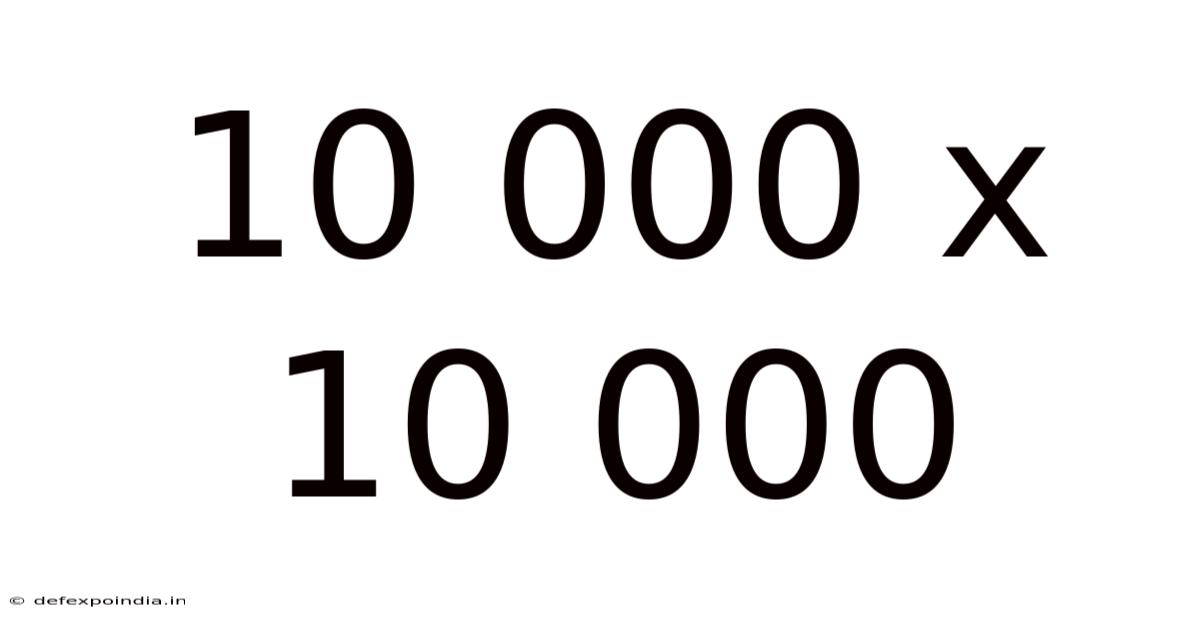
Table of Contents
Exploring the Immense Scale of 10,000 x 10,000: A Journey into Gigantic Numbers
The seemingly simple calculation of 10,000 multiplied by 10,000, resulting in 100,000,000 (one hundred million), might initially appear unremarkable. However, delving deeper reveals a fascinating exploration into the vastness of numbers, their practical applications, and the limitations of our human perception of scale. This article will journey beyond the simple arithmetic to understand the true magnitude of 10,000 x 10,000 and its implications across various fields.
Understanding the Calculation and its Result
The calculation itself is straightforward: 10,000 x 10,000 = 100,000,000. This is a basic multiplication problem, easily solved with a calculator or even mental math for those familiar with powers of ten. The result, 100 million, represents a significant number, but its true meaning only becomes apparent when we consider its context. We're not just dealing with a simple numerical value; we're dealing with a quantity that surpasses our daily experiences.
Visualizing 100 Million: From Grains of Sand to Stars in the Sky
Trying to visualize 100 million units is a challenge. Imagine trying to count 100 million grains of sand. Even if you counted one grain per second, it would take you over three years of continuous counting, without sleep or breaks! This demonstrates the sheer magnitude of the number.
Consider another analogy: The population of many large cities worldwide is well below 100 million. Therefore, 100 million represents a population larger than many significant urban centers. This scale transcends our immediate surroundings and pushes us to think about quantities on a global or even cosmic level.
Another fascinating perspective is to relate 100 million to the number of stars in a galaxy. While the Milky Way contains hundreds of billions of stars, smaller galaxies might contain a number closer to 100 million. This allows us to connect the seemingly abstract number to a tangible, albeit immense, cosmic entity.
Practical Applications of this Scale: Data, Finance, and Beyond
The number 100 million finds practical applications in diverse fields.
-
Data Storage and Processing: In the realm of computing, 100 million represents a substantial amount of data. Think of 100 million images, documents, or data points. This highlights the need for efficient data storage and processing capabilities in modern technology. Handling and analyzing datasets of this size requires sophisticated algorithms and powerful hardware.
-
Finance and Economics: In finance, 100 million could represent the value of a large investment portfolio, a substantial government budget allocation, or the total revenue of a moderately sized company. Understanding this scale is crucial for financial planning, risk assessment, and economic modeling.
-
Scientific Research: In scientific research, 100 million could represent the number of particles in an experiment, the number of data points collected in a large-scale study, or the number of iterations in a complex simulation. The scale demands robust methodologies and powerful computing resources.
-
Global Population Statistics: While the global population is far larger, 100 million still represents a significant fraction of humanity. Considering this portion of the world's population is invaluable for understanding issues like resource allocation, public health initiatives, and global development.
-
Environmental Studies: The number can represent the quantity of trees in a vast forest, the number of organisms in a specific ecosystem, or the volume of water in a large reservoir. Understanding this scale is crucial for environmental conservation and management.
Mathematical Explorations Related to 10,000 x 10,000
Beyond the basic multiplication, we can explore various mathematical concepts related to 10,000 x 10,000:
-
Scientific Notation: Expressing 100,000,000 in scientific notation simplifies the number to 1 x 10⁸. This concise representation is crucial in science and engineering, where dealing with extremely large or small numbers is common.
-
Powers of Ten: The calculation 10,000 x 10,000 is essentially 10⁴ x 10⁴ = 10⁸, showcasing the rules of exponents. Understanding powers of ten is fundamental in mathematics and many scientific disciplines.
-
Logarithmic Scales: When dealing with such vast ranges, logarithmic scales become necessary for effective visualization and analysis. A logarithmic scale compresses the range of values, allowing for better representation of data spanning many orders of magnitude.
-
Order of Magnitude: The calculation illustrates the concept of order of magnitude. The result is on the order of 10⁸, indicating a scale significantly larger than 10⁶ (millions) but smaller than 10⁹ (billions).
Beyond the Numbers: The Limitations of Human Perception
Despite our ability to perform the calculation and even understand the practical applications, grasping the true immensity of 100 million remains challenging. Our brains are not naturally equipped to comprehend such vast quantities intuitively. This limitation highlights the need for creative visualization techniques, analogies, and mathematical tools to help us navigate the world of extremely large numbers.
Frequently Asked Questions (FAQs)
-
Q: What are some real-world examples where we encounter numbers of this magnitude?
- A: The number of bytes in a large database, the total number of transactions processed by a major bank in a year, the total number of views of a highly popular online video, the number of grains of sand on a large beach (approximately).
-
Q: How does this relate to other large numbers?
- A: 100 million is significantly smaller than a billion (10⁹), a trillion (10¹²), and so on. Understanding the differences in scale between these numbers is essential for working with very large quantities.
-
Q: Are there any mathematical or computational challenges associated with handling numbers of this size?
- A: While modern computers can easily handle this number, processing and analyzing datasets with hundreds of millions or billions of data points can still present computational challenges. Efficient algorithms and data structures are crucial for managing large-scale data.
-
Q: What are some ways to improve our intuitive understanding of large numbers?
- A: Using analogies, visualizations, and logarithmic scales, as well as breaking down large numbers into smaller, more manageable parts can significantly improve our understanding of scale.
Conclusion: A Deeper Appreciation for Scale
The seemingly simple calculation of 10,000 x 10,000 unveils a world of immense scale and complexity. While the arithmetic is basic, the implications extend far beyond the realm of simple mathematics. Exploring the practical applications, mathematical interpretations, and limitations of human perception associated with 100 million provides a valuable lesson in appreciating the vastness of numbers and their significance in our world. Understanding this scale empowers us to better comprehend the challenges and opportunities presented by the increasing amounts of data, complex systems, and global issues we face today. From grains of sand to stars in the sky, the journey into the realm of 100 million is a journey into the vastness of the universe and our place within it.
Latest Posts
Related Post
Thank you for visiting our website which covers about 10 000 X 10 000 . We hope the information provided has been useful to you. Feel free to contact us if you have any questions or need further assistance. See you next time and don't miss to bookmark.
