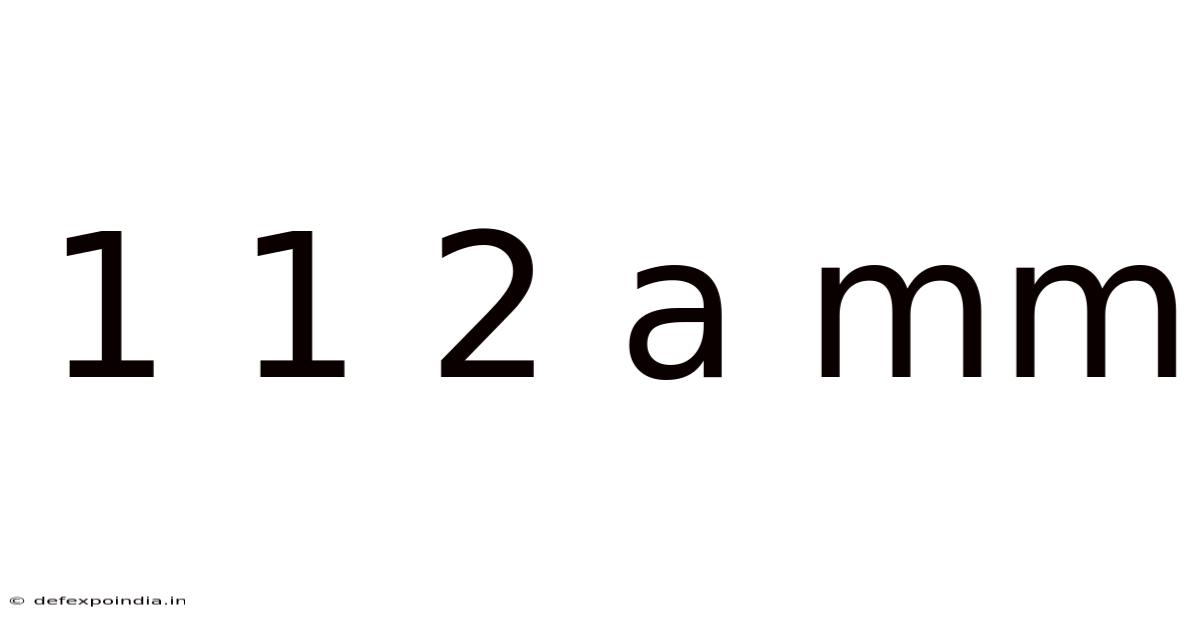
Decoding 1 1 2 a mm: Exploring the World of Metric Conversions and Precision
The seemingly simple sequence "1 1 2 a mm" might initially appear cryptic. Even so, it hints at a fundamental concept in measurement: the precision and accuracy required in various applications, particularly in engineering and manufacturing. This article breaks down the meaning and implications of this notation, exploring metric conversions, the significance of decimal places, and the importance of precision in different fields. We'll also address potential interpretations and ambiguities within this notation.
Understanding the Notation
The notation "1 1 2 a mm" likely represents a measurement expressed in millimeters (mm). The "a" is the key element that introduces ambiguity. It could signify different aspects depending on the context:
-
Approximation: The "a" might represent an approximation or an estimated value. In this case, the measurement isn't precisely 112 mm but rather close to that value, possibly within a certain tolerance. This is common in situations where exact measurements are difficult or unnecessary.
-
Average: The "a" could indicate an average of several measurements. As an example, multiple measurements taken might have yielded values slightly above and below 112 mm, resulting in an average of 112 mm.
-
Arbitrary Unit: Less likely, but possible, "a" could stand for an arbitrary unit within a specific system not directly related to millimeters. This interpretation requires further context to be valid And that's really what it comes down to..
Metric Conversions and the Importance of Units
Before proceeding further, understanding the metric system is crucial. Now, the metric system (also known as the International System of Units or SI) is a decimal system based on units of ten. The millimeter (mm) is a unit of length, equal to one-thousandth of a meter (m).
- Kilometer (km): 1 km = 1000 m
- Meter (m): The base unit of length.
- Centimeter (cm): 1 cm = 0.01 m (or 10 mm)
Accurate conversion between these units is essential. Consider this: converting to meters would require dividing by 1000: 112 mm / 1000 mm/m = 0. 2 cm. To give you an idea, converting 112 mm to centimeters involves dividing by 10: 112 mm / 10 mm/cm = 11.112 m.
Precision and Significant Figures
The concept of significant figures is crucial when dealing with measurements, especially in scientific and engineering applications. Also, significant figures represent the number of digits that carry meaning in a measurement. They indicate the level of precision of the measurement.
- 112 mm: This measurement has three significant figures. It implies the measurement is accurate to the nearest millimeter.
- 112.0 mm: This has four significant figures, indicating higher precision (accurate to the nearest tenth of a millimeter).
- 112.00 mm: This has five significant figures, implying even higher precision (accurate to the nearest hundredth of a millimeter).
The ambiguity introduced by "a" in "1 1 2 a mm" directly impacts the number of significant figures and, consequently, the precision implied. Without further clarification, the precision remains uncertain.
Applications and Contextual Significance
The importance of precision varies greatly depending on the application. Which means in some instances, a rough approximation is sufficient. Take this: measuring the length of a piece of string for a craft project might not require extreme precision.
-
Manufacturing: In manufacturing precision components, such as microchips or engine parts, deviations of even a few micrometers can render the product unusable. The accuracy of measurements is very important. The tolerance (allowed variation) in these industries is extremely tight.
-
Engineering: Civil engineering projects require precise measurements to ensure structural integrity and safety. Errors in measurements could have catastrophic consequences Worth keeping that in mind..
-
Scientific Research: Scientific experiments demand extremely high precision, especially in fields like nanotechnology or particle physics. The accuracy of measurements directly affects the validity of the research results.
Possible Interpretations and Ambiguities
Let's explore some potential interpretations of "1 1 2 a mm" considering different contexts:
-
Scenario 1: Rough Measurement: A carpenter estimating the length of a wooden plank might record it as "1 1 2 a mm," where "a" implies a rough estimation within a few millimeters of 112 mm. The precision is low, and the exact value is unimportant for the task Worth keeping that in mind..
-
Scenario 2: Averaged Measurement: A technician taking multiple measurements of a component using a less precise instrument might average several readings, resulting in "1 1 2 a mm," indicating that the average value is approximately 112 mm. The "a" signifies the averaging process Small thing, real impact..
-
Scenario 3: Measurement with a Defined Tolerance: In a technical drawing, "1 1 2 a mm" might specify a dimension with a tolerance defined elsewhere in the document. The "a" is a placeholder indicating the exact tolerance needs to be looked up in the specification document. This is more likely to be indicated with a +/- value (e.g., 112 mm +/- 0.5 mm).
Troubleshooting and Best Practices
To avoid ambiguity, it's crucial to use clear and unambiguous notation when recording measurements. Here are some best practices:
-
Specify Units Clearly: Always include the units (mm, cm, m, etc.) to avoid any confusion.
-
Use Decimal Places: Employ decimal places to indicate the level of precision. If the measurement is accurate to the nearest tenth of a millimeter, write 112.0 mm.
-
Specify Tolerance: If a tolerance is involved, explicitly state it (e.g., 112 mm +/- 0.1 mm).
-
Use Standard Notation: Adhere to standard scientific notation and significant figure rules.
-
Contextual Clarity: see to it that the context of the measurement is clear. Providing additional information will eliminate ambiguity Took long enough..
Conclusion
The seemingly simple notation "1 1 2 a mm" highlights the critical importance of precision and clarity in measurements. Understanding the metric system, significant figures, and the potential ambiguities introduced by vague notation is crucial for accurate communication and problem-solving, especially in engineering, manufacturing, and scientific fields. Also, adopting best practices in measurement recording prevents errors and ensures that information is interpreted correctly. Which means always strive for clear, unambiguous communication regarding measurements to avoid costly mistakes or misunderstandings. Remembering the context, precision, and proper use of significant figures will make your measurements far more useful and reliable Practical, not theoretical..
